Friday, October 5, 2012

SAP Financials OnDemand .. A Primer

Hello folks,

Maybe you have heard that we are just about to launch an exciting new member of the SAP Cloud family at SAPPHIRE NOW in Madrid in November. As we gear up for this launch, I am writing a series of blogs to formulate my thoughts about the solution. Today I'd like to give you all a basic primer on what SAP Financials OnDemand is all about.

I think the first thing to address is the role of a modern finance department and what issues and challenges they face today that prompted us to develop a brand new solution for this space.

Some of you might think that the area of finance has been around for such a long time that the processes of basic accounting, reporting, controlling should be well under control. Why should there be such an urgent need for renovation? Here is why. Research has shown, that most finance departments would like to move away from being purely operational to becoming more strategic. CFO's are being tasked to become more of a driver for sustainable and profitable growth for the entire enterprise. The reality today is, however, that most finance professionals are actually "stuck in reporting hell". Instead of rapidly analyzing information and providing insight to executive management for real time action, teams of highly trained professionals spend much of their time in data consolidation, aggregation and, often, redundant corrective action based on the fragmentation of systems and general ledgers that has accumulated over the past decades. This is the reason why we felt the time was ripe to develop a new Financials Engine that can drastically transform this area.

Let me give you one example where we can really help with this new solution: Many large companies have systems with potentially 1000's of general ledger accounts. For example, enterprise would typically have a General Ledger account for meals and entertainment that gets replicated for each department, and sometimes even at the project level. This large and proliferating number of accounts is unwieldy, hard to report against, and frankly not agile enough to deal with today's demand for a modern financials department. Another problem is the common software development practice of  using a so-called "coding block" to embed meaning within a string of numbers such as 09092000307652. In this case the first three digits 090 could mean company code, then a department code 920, then an expense type 0003, etc. This deep meaning embedded in a string of numbers was invented at a time when memory was scarce, storage was at a premium and financial systems were built for experts. This "hangover" from older system architectures persist today and can make financial systems very hard to change.

So how are we addressing these issues (among a ton of other things which I will cover in later blogs) with SAP Financials OnDemand?

Above all, SAP Financials OnDemand is based on an innovate In-Memory architecture using SAP HANA.  SAP HANA is a completely new way to extremely rapidly store and retrieve information in it's rich, native format using a flexible approach to reflect multiple real-world attributes and business dimensions. Using SAP HANA powering SAP Financials OnDemand, enterprises can drastically increase the flexibility in which they store and retrieve general ledger entries, giving them virtually unlimited flexibility to report on any business dimension they chose. The idea is to enable enterprises to get out of the game of generating a scattered landscape of many many specific-purpose and potentially rigid general ledgers. The idea is to minimize, if not completely doing away with time consuming and complex reconciliation! With SAP Financials OnDemand enterprises can fundamentally simplify the task of creating a single source of truth that is not only much more flexible, but also drastically easier to use and more relevant for everyone in the enterprise.

Are you bored yet? I would not blame you since this stuff is usually reserved for experts. Let's bring it back to the end user level, to average Jane and Joe, if you will. Most of you are probably working in jobs where you would like to have accurate real-time information ready at your fingertips any time and anywhere. But you still don't have that. How come?

Isn't it true that there are great analytical and business intelligence tools out there? Yes!
Isn't it true that there are data warehouses, and data marts that provide multi-dimensional reporting for anyone in the enterprise? Yes and Yes! There has been tremendous progress over the last 40 years to get data out of systems and to aggregate them, enrich them and deliver the information to a great  set of tools.

But ...

What's important is that the transactional systems that are the source for these business intelligence tools are mainly intended to run todays's billion € a second globally connected economy. THEY WERE BUILT FOR TRANSACTIONS. And these systems will stay in place. They will continue to be enhanced. And they will continue to feed the "Analytics Farms" and Business Intelligence engines that feed decision making today.
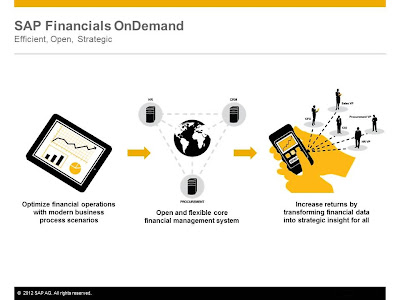
But what about brand new systems for new companies, new divisions, new joint ventures and new projects? Should we go accept the limitations of pure transactional systems, the limitations of rigid coding blocks, the limitations of the need for aggregation, the limitations of separate reporting systems? I don't think so. And there is no need to do so any longer.

With SAP Financials OnDemand you will get a system that is built on 40 years of experience with providing the heavy lifting needed to power financial transactions for the global economy. But SAP Financials OnDemand was not built around just transactions, compliance and reporting. It was build around the concept of a single, trusted source of truth that can be the foundation for insight and collaboration for everyone in your enterprise.

It think this basic value proposition is captured fairly well in the following short video clip produced by the team gearing up for the launch.

http://www.youtube.com/watch?v=RQL2dyiqCqE&feature=youtu.be

I hope this short blog has given you a bit of perspective of what we are trying to do with SAP Financials OnDemand. I look forward to your questions and comments

CHHO, Vierkirchen, Oct. 5, 2012


Thursday, October 4, 2012

A Financial Engine is like a tree ... a different view

Whenever we talk about software, no matter if it is developed for on-premise deployment or for the cloud, we marketeers usually invoke a lot of technical analogies: Control rooms, cockpits, traffic hubs, infrastructures, diagrams on screens, data on mobile phones, etc. The perception seems to be that it's all about technology, its all about data, it's all very clean and sterile. I really don't like that very much.

Last evening I was thinking about the global economy and the new role of the "strategic" CFO that is going beyond the classic back-office job of accounting, budgeting, planning, controlling, reporting, governance and compliance into the much more strategic role of enabling sustainable and profitable growth for the whole enterprise. And I was thinking: "Why can't we - for once - use a different analogy for explaining how a modern Finance Engine needs to work?" The analogy that came to mind was the picture of a tree.

"A tree?", you might ask. Let me try to explain my thinking here.
(a) A tree has a strong foundation in its root system. The root system is deeply embedded in the environment and provides stability and nutrition to the entire organism. A modern Finance Engine also needs to be deeply rooted in the enterprise environment, being able to extract information from all business areas to provide a single source of truth.

(b) A tree is supported by a strong but flexible trunk that grows every year in a structured way. This is comparable to the foundational capabilities of a modern Finance Engine that provides all the reliability, security, governance and basic accounting capabilities needed for an enterprise CFO to not only run their business, but to stay compliant and provide data to everyone in the enterprise, in a format that is easy to consume (Tree Nutrition, ironically, is called sap).

(c) A tree is also characterized by its system of branches, supporting leaves or needles and/or fruit. In a modern Financial Engine this analogy relates to the ability of the tree to reach out to all areas of the business, even the smallest leaf to enable bi-directional communication and production.

(d) Last but not least, a tree is usually embedded in a rich and vibrant ecosystem, for example a forest, partaking in a system of sustainable and dynamic interchange, synergy and often symbiosis. This could be related to the capability of a modern Financial Engine to be easily connected to other systems, be it in a business-to-consumer or in a business-to-business context.

You are probably already thinking about the 59 ways this analogy does not make sense.

"This silly analogy misses this, and it distorts or misrepresents that .. ".

Go ahead, critique, find fault, correct away to your hearts delight... ! I am fine with that! I think analogies are most useful when they stimulate a new way of thinking about something. For me it helps me think about launching our newest addition the cloud family, SAP Financials OnDemand. By thinking of the solution being like a tree, it makes me remember a number of key things we need to absolutely respect:
  • If we want to put a new tree (new financials engine) into an enterprise, we need to respect that there is already a tree in place with an existing, deeply embedded root system, branches, and symbiotic relations with its internal and external ecosystem.
  • When you put in a new tree, you typically start with a small tree that's carefully nurtured and protected and allowed to grow alongside the existing tree until its ready stand alone and to bear fruit.
  • You have to put a tree into the appropriate environment. Putting a palm tree into northern Alaska does not make a lot of sense. Nor does it make sense to place a new Financials Engine into an industry that requires specific, deep industry adaptations out of the box that the young "tree" might not have grown.
The list could go on, but I will stop the analogy right there. After all, this is just my personal blog about the random thoughts of an enterprise marketeer, looking for feedback and inspiration from the global hive mind.

In my mind, the analogy will live on, however. Don't be surprised if we put pictures of magnificent trees or forests at the front of our customer presentations. I personally think it is important to think about Financial Engines not in terms of technology, but in terms of an organic system that has to flex and grow, that exist in a sustainable fashion inside an ecosystem, and that is, simply stated, a beautiful thing to look at and enjoy. 

Walldorf, October 4, 2012
CHHO


Tuesday, October 2, 2012

The New Financials Engine for the 21st century


As we go through the positioning and messaging process for SAP Financials OnDemand (our latest addition to the SAP Cloud portfolio), I am reminded of the big innovation wave of the 90’s when Michael Hammer’s Business Process Engineering book took the industry by storm, and created a huge wave of demand around transformation projects as well as Enterprise Resource Planning (ERP) software, which made SAP the market leader we are today.

I think we are just at the beginning of a new, huge, very similar innovation wave for financial software (the perfect storm of innovation if you will), because of the convergence of a lot of concurrent technology trends, including In-Memory, Analytics, Big Data, Cloud, Mobile and Social. 

"Yeah, Yeah", you're thinking, "here we go again with a marketeer yakking away about innovation .. we've heard it all before ..."

Really? Let me lay out my thought process here ...
  • The ERP systems of the 90’s were built around transactions, not decision-making or analyticsà leading to lot of pain of transformation and integration
  • They were built for transparency and governance/compliance, not for collaboration and instant action à leading to frustration and delays
  • They were built for finance experts, not for everyone in your company à leading to duplication and losses in translation

The world has moved on. Business processes have moved on. People’s work style has moved on. Enterprises still need all of the foundational capabilities listed above in their trusted financial backbone (Transactions, Transparency, Governance/Compliance, Financial Excellence) but, more than ever, need to add support for the 21st century style of work as well. Finance has to move out of the boring but essential back-office paradigm of operations and reporting and move into a key position for driving growth and change in enterprises. But how? 

In comes SAP Financials OnDemand, which is already shipping in its first iteration, and will hit its first refresh in November of 2012. Here is a short overview of the system characteristics which I personally think offer a very interesting case for taking a closer look. 
  • Single Source of Truth
    • Reconciled data (true data) along multiple dimensions reflecting the real world in real time
  • Real Real time
    • Based on In-Memory technology, designed for analytics, and doing away with the separation between transactional and analytical data stores
  • Intuitive
    • Designed to be easy to use for anyone in your business, not just the financial experts
  • Mobile
    • Native support for mobile devices including iPad and Windows8, getting the informaton to the people whereever they may be
  • Collaborative
    • Built-in workflows and community support so people can take immediate action
  • Open
    • Embedded process library with open integration links to processes beyond the the scope of the built-in order-to-cash and procure-to-pay scenarios
    • Extensible architecture based on Web-Standards
    • Software Development Kit
  • Extensible
    • Other SAP Cloud Applications easy to "clip on" (SAP Travel OnDemand, SAP Sales OnDemand, etc.)
    • Available Application Connectors for non SAP applications, Payroll, Sourcing, etc.
    • Easy business-driven configuration (Click-to-Adapt technology)
  • Global Compliance
    • Global Accounting Standards (IFRS, US-GAAP, ..)
    • Internal controls built into the processes
    • Localization for multiple languages, currencies, ...
  • Trusted Cloud
    • Cloud Certifications in Germany, US ..
    • Trusted Data Centers around the world
  • SAP Ecosystem
    • 40 years of business process excellence
    • 1000's of partners in global ecosystem
I think if I were a CIO, I'd take a serious look at this right now. A system built by SAP, that can DRASTICALLY simplify my general ledger landscape and EXPONENTIALLY  increase my speed and flexibility in terms of reporting for everyone in my business?

Does that mean people will throw away their existing financial systems and upgrade to SAP Financials OnDemand over night? Heck no! Of course not. Trillions of € are invested in these systems and they form the backbone of the global economy. That would be like trying to do a heart transplant on a marathon runner  WHILE HE IS IN THE RACE. Impossible. But. What IS possible, is to kick-start a new wave of process engineering, or financials re-engineering, if you will. In a an approach of open co-innovation, where we'd look at your specific business situation, identify the opportunities together, focus on the fast moving areas that need accelerated innovation more than others ... and get it done. I am personally excited to be part of this new wave. I missed the fun and excitement when this happened in the 90's (I was playing with databases and middleware then). But I am not going to miss this one .. actually, I am the Launch Captain for the November refresh. 

The Launch is coming. Get on board, you don't want to miss this one ...

CHHO, Walldorf, Oct 2, 2012

Saturday, September 29, 2012

The road to HAL is paved with good inventions

Hello folks

Maybe this article caught your attention too

Artificially Intelligent Game Bots Pass the Turing Test On Turing's Centenary

It seems like we are slowly but surely making progress towards the creation of an Artificial Intelligence (AI). But I think the  HAL 9000, as envisioned by Arthur C. Clarke in his screen play for Kubrik's "A Space Odyssey" is probably still as far away from realization as ever. And that's a good thing. We don't want HAL around, trust me.


"Wait"! .. you shout. "What about the article above? What about all the other progress? The Petabyte InMemory engine that will simulate an entire universe? What about the Siri app on my iPhone which is so cool?" ... etc.

My point is that we might be severely misguided in our approach to creating an artificial intelligence by trying to model it on the human mind and then shoving that model into an evolved toaster aka. machine. To use the human mind as model, the human mind would have to be a good and useful thing to model in the first place! Something worth reverse engineering, copying and mass producing. But that's exactly what the human mind is not.

Human minds are fuzzy. Human minds are influenced by emotions (a.k.a. the chemical cocktail sloshing about in our water filled skin bags we refer to as our bodies). Human minds make lots of mistakes; as a matter of fact, we are practically stumbling through life relying on a set of half-baked assumptions, available data heuristics, wild guesses, and intuitive judgement calls we usually explain as "rational" only after the fact. Do we really want a machine with potentially million-fold speed, physical power to acquire Jeffrey Dahmer levels of thinking and acting? I hope you get my point.

Let me elaborate.

I think its about time we change the definition of the TLA (Two-letter acronym) A.I. from "Artificial Intelligence" to "Augmented Intelligence". If you redefine it that way, we have already achieved leaps and bounds in AI.

  • Augmented Intelligence, Phase I (AI-1) was and still is basically the use of books, maps, and all manner of tools like compasses, abacuses, microscopes and clocks to make better sense of the word and augment our minds that way. Most of the world is still in that stage, and some have not even reached that level because they are unable to acquire reading skills or books or tools. As for the industrialized world, we might be proud of our Smart Phones, Portals, Siri's and Blogs, but its still essentially a Phase I model where these tools are simply helping us to get a job done, when we need the job done.
  • AI, Phase II (AI-2)  kicks in when systems, programs, software, apps, whatever you may call them, start acting and making decisions on your behalf, based on rules and exceptions you have set for them. You might want to think of these rules and exceptions that allow systems to act for you as your "Avatar", your digital butler, your concierge. This goes beyond the automatic transfer into your kid's savings account at the end of the month, since that's repeated mindlessly until cancelled. It's more related to the automated trading and booking systems in the financial world. Part of the world is in AI, Phase II, and the advent of ubiquitous 3rd Generation Mobile Networks, affordable smart phones, cloud computing to simplify development and deployment of applications will ensure that AI Phase II will rapidly spread to the parts of the world with access to free internet and free speech.
So, you might wonder, what's next? Is AI, Phase III the HAL 9000 that thinks independently and eventually decides to destroy its redundant maker? I hope not. And I hope we stop trying to get there before it's actually too late. 

I think we are already in the middle of Phase III of Augmented Intelligence (AI-3), which is the phase where our minds are continually augmented and supported not only by technology in terms of systems and software, but by other humans as well. I think of AI-3 as the emergence of the global hive mind, a cloud of connected communities of like-minded individuals, retaining their individuality but benefiting from the real-time access to other opinions, expertise, creativity, networks and resources, even to financing available near real time, on-demand.

This is not science fiction. This is real. If you take the combination of social platforms like FaceBook and Twitter, combined with near ubiquitous and instant access to information via your smart phone, and combined with near-real time analysis of massive amounts of information (Big Data), the advent of augmented reality interfaces with tagging of objects, simple cloud applications that are easy to learn and use .... most if not all the infrastructure is already there. 

I think this is what most people are missing when thinking about AI. While some folks are still chasing the mirage of building HAL, Augmented Intelligence Phase III is already here. If you are reading this, you are part of it. Part of the emerging global hive mind.. the question is .. what are you doing to make it even better for all of us? 

I have decided that blogging is my 6 cents contribution. 

CHHO, Vierkirchen Sept 29, 2012


Summer's waning, time to blog again

September is rolling down the shutters. Summer has packed her suitcase and is headed south. Fall is parked outside the window and has begun to paint the landscape in his colors. It's dark when I leave office these days, longer evenings beckon.

So I think its blogging season again (blogging seems a seasonal thing for me)

The reason I have not updated my blog more often is not that I had nothing to say. Plenty of random thoughts on SaaS, Paas, Software and Services in general, and marketing in particular crossed my mind, and begged to be written up. But I never felt that these random musings were interesting enough for anyone to actually give a dang. Well, I changed my mind. What changed my mind? I just completed a live radio show with blogger celebrities Frank Scavo and Jon Reed, and it was a ton of fun to throw an opinion out there, and have it challenged in public. I had really missed that. And that's what I am going to use this platform for.

Its bait for debate.

Stay tuned, don't touch that dial

CHHO

Friday, September 16, 2011

Gaming is the only real game changer

After seeing Jane McGonigal's TED lecture regarding the emerging influence of gaming and gamers - (http://www.ted.com/talks/jane_mcgonigal_gaming_can_make_a_better_world.html)
I thought it worth while to write a short post on how this relates to enterprise software and cloud. I firmly believe that the gaming community is becoming a real game changer for enterprise software as well as consumer software, and it is driving adoption of the cloud even faster. The hype term of "gamification" does not begin to do justice to this trend, as it tends to focus on attributes of the software, not on the consumption attributes of the emerging gaming community.


Think about its this way:
  • Today, there are 500 million gamers out there playing more than one hour per day, mostly online and mostly networked with other gamers
  • By 2020, there will be 1.5 billion gamers online (talk about a market segment)
  • By reaching age 18, many of today's gaming kids will have spent 10000 hours or more online: Collaborating, solving complex problems, teaming up to achieve epic wins, etc.
    (a new set of skills is forming here around real-time online collaboration)
  • The gamers' expectations on software, any software, consumer or enterprise, are rapidly and drastically changing (talk about instant gratification, dramatic simplification, etc.)
The enterprise software industry can only learn from this market in terms of:
  • how to fully utilize online communities from the first idea to the final realization of the product
  • how to make platforms that are easily extended by the people 
  • how to make things intuitive and fun to keep people loyal to the product
  • how to use visualization to make complex things look easy
  • how to tie together communications media and consumption models (chat, voice, video streaming, platform and component download, communities, updates, etc) into a seamless fabric focused on the gaming experience
  • how to create a fan-driven ecosystem around the product and brand
This list could go on and on. There is a sea change under way in software, and its not just about games. Its about an online, global community of highly intelligent, collaborative, fun-oriented people of an increasingly diverse age group that will shape the face of software more than any software maker ever has in the past. 


I am fortunate that I have an avid gamer in my family that is teaching me a lot about this business. 


If you are in enterprise software, and if you are interested on what the cloud can become, talk to a gamer, and get ready to be surprised

Walldorf, 10.09. 2011


Friday, May 21, 2010

Starting CIO2CIO


It sounds like a simple enough idea. Let's connect the CIO of SAP (Oliver Bussmann) who is running one of the largest SAP landscapes in the world, with the CIO of our customers in a non-sales, non-marketing, open dialog conversation.

We kicked this off at this year's SAPPHIREnow show in Frankfurt. Customer CIO's responded very favorably to this idea and I think we will get a lot of super-valuable feedback from the process.

Why have we not done this before?

Well, I think there are a lot of changes happening at SAP that makes this possible, and one of these changes, is a change of culture and leadership style. Oliver is part of this change, and I am happy to help him frame the messages, and turn this into a value added experience for our clients.

If you'd like to meet Oliver and get his perspective CIO to CIO, comment on this blog or send me a mail and I'll see what we can do to set this up.

Best regards

CHHO

Thursday, April 29, 2010

Process Orchestration ... another silver bullet?

I am writing this as I return from a very interesting internal discussion to prepare my moderation of an upcoming panel at SAP SAPPHIRE NOW called "Process Orchestration, Hype or Silver Bullet?"

Initially, this looked straight forward enough. Invite some customers and have an engaging chat about process orchestration. No problem. Well ...

The more people I speak with, the more interesting perspectives I get on Process Orchestration. It's like, you ask 9 people and come away with 11 opinions. And all of them seem valid.. what gives?

Here is what I have learned so far:
  • In the most simple terms, process orchestration means the coordination of events in a process.
  • In a slightly more complex definition, it is the tools and practices needed to ensure process integrity in a landscape of distributed process components
  • In its most forward looking interpretation, it is the new mission statement of enterprise applications, as they transform from handling focused LOB level processes to an overall business process platform that is able to deliver process innovation and process integrity at the same time.
So far this is not much different from what we have been saying about SOA and BPM for the past decade or so. What's changed? Why is Process Orchestration all over sudden shifting into the lime light? Is this just another one of the "hype-de-jour" IT industry "flash-in-the-pan" movements or is there a serious shift happening?

As I usually say in these blogs, quoting sage Yogi Berra "predictions are hard, especially when they are about the future". But maybe we can learn something from the past, to make the future more easy to anticipate.

When BPR or Business Process Re-Engineering became "hot" in the beginning of the 1990's, the message to the enterprise was to get rid of functional silos and look at end to end processes. This, among other things, lead to the emergence of a new category of software we now refer to as ERP, and to the development of end-to-end suites, to replace the brittle landscape of best-of-breed applications.

Now, history seems to repeat itself. Functional silos seem to be having a renaissance. Why? Because of the rapid emergence of SaaS and On-Demand point applications that are easy to buy and easy to install, customers are lured in by the attractive prospect of rented software in a pay-as-you-go model to avoid lengthy and expensive implementations and to realize the value proposition of enterprise software more quickly. So you buy a bit of SFA here, a bit of HR talent management here, a bit of SRM there and there you go .. you have a completely functional on-demand suite ......

AND THEN YOU WAKE UP ...

I think the topic of Business Process Orchestration is hot, and becoming hotter as we speak, because more and more customers are realizing that they need to watch out for the brittleness of these new best-of-breed "archipelagos" of SaaS applications. Who owns the master data? Who ensures process integrity? Who instruments the landscapes for insight and analytics? Who ensures updates to one app don't kill the integrity of an end to end process? Who maintains your identities? etc. etc. Problems are well defined and addressed in enterprise software suites are being created all over again. This does not make a lot of sense to me, but it is happening with a vengeance nonetheless.

Humans have short term memories when it comes to pain.

I believe customers should be looking to their enterprise application vendors for a holistic approach to process orchestration. Not just a few tools, but for a comprehensive approach including:
  • ALM (Application Lifecycle Management) ... in other words: How do you manage the integrity of your landscape and keep things in synch?
  • MDM (Master Data Management) ... in other words: How do you ensure the integrity of your data model including identities and meta data across potentially 100's of small applications running on-premise, on-demand and on-device?
  • BPM (Business Process Management) ... in other words: How do you ensure process flexibility and integrity in a model driven approach that fully leverages what you already have?
Once you think this through, it becomes clear that multiple categories of software should converge to create this Process Orchestration Vision. This should lead to the coordinated delivery of a process orchestration suite that melds BPM, ALM and MDM as well as event-driven and rules-based analytics into a new concept that is still looking for a name.

aside: Maybe this is a move from classic Message Oriented Middleware (MOM) to Process Orchestration Platforms (POP) :=) ??

Once this happens and gets delivered, the classic separation between transactional, analytical and collaborative applications can blur, especially in an hybrid landscape where on-demand, on-premise and on-device applications will co-exist as the new architectural standard. Customers will come to expect collaboration, insight and integrity "Out of the box" ... without the need to glue things together after the fact with classic middleware.

With this, Business Process Orchestration becomes the secret sauce, the foundation of a new breed of enterprise software that combines the flexibility and ease of consumption of SaaS with the integrity and reliability of enterprise software.

It will be an interesting space to watch. I look forward to the SAPPHIRE NOW panel, and what our customers have to say about this, and what they're getting out of IT. Because in the end, that's the only thing that really matters.

My 5c for today

CHHO

Friday, August 21, 2009

The TOP-3 impactful IT trends -- or is it really just ONE?

Over the weekend I had to make up my mind which 3 IT trends are most impactful to prepare for a short editorial in a german magazine. The reason I say impactful is that this industry is usually so full of hyped up trends that it sometimes becomes difficult to sort the wheat from the chaff. Impactful means what is really making a dent in the way companies purchase and deploy IT products, as opposed to what are they all talking about. .

So, trying to avoid bias, and instead of wrecking my own brain, I decided to ask the crowd on twitter for some ideas, and within 24h I had a few responses, which are visible inthe comment section below. Although there are only 4 responses (admittedly not exactly a statistically significant sample), the one trend all seem to mention is cloud computing.

Notably absent is the trend around social computing, which I think is as significant as cloud computing.

The combination of these two key waves of change is significant because they have a common underlying cause. The sea change in IT away from scarcity (little of everything: memory, disk, users, locations) to abundance (masses of everything: memory, disk, users, locations). Of course not everything changes from scarcity to abundance. IT resources are continuing to shrink in terms of IT staffing and budget. This, in my personal opinion, is forcing the third mega trend: Simplification

So, what do we have now:

(1) Cloud computing (incl. virtualization, anything-as-a-service, on demand, etc.)
(2) Social computing (incl. social media, web and enterprise 2.0, collaboration, mobile, etc.)
(3) Simple computing (incl. any data everywhere all the time, better user interfaces, etc.)

If one had to combine these 3 trends into a single term one might chose CROWD COMPUTING,
defined as an approach that leverages the abundance of memory, disk, users and locations while keeping cost and compexity to a minimum to make this approach truly sustainable for the masses.

Can one make a prediction based on this? Probably not. But, if you have read Taleb's "Black Swan" you probably agree that our ability to predict things is invesely proportional to our desire to do so. So I will refrain from any predictions and keep with Yogi Berra who said:

"Predictions are hard, especially when they are about the future"
AND
"The future ain't what it used to be"

So, while I am not trying to make any predictions, I think one can safely assume that the speed of change will continue to increase and it will be ever more impossible to accurately predict what will happen in the world of IT. However, one thing seems to be clear. If the trends of Cloud, Social and Simple computing truly converge into a sea change around CROWD COMPUTING, any enterprise software that is not quickly moving in this direction right now is faced with a severe challenge.

What do you think about CROWD COMPUTING?

CHHO


Friday, July 17, 2009

Timeless Software

I just recently got assigned as the marketing lead for the Office of the CTO at SAP.

One of the things I am working on is to take the concept of Timeless Software (that our CTO Vishal Sikka has been talking about for quite some time), and find out how the concept is being received by the various constituents and target groups, take in their feedback, and improve the communication around it.

It's a fun assignment. You talk to 10 people about it, and you get 11 opinions. But the interesting thing is, everyone seems to have an opinion. Timeless Software seems to resonate at a fundamental level as something that "sounds right". But there is still quite a journey ahead to not only validate the concept, but to fine tune the message around it to the various target groups.

It's still early days in the project. I will have to talk to a lot of people to really get a good understanding of the different interpretations of timeless software. But one thing has already become clear, even though the names and labels might still change a bit over time.

Applying the newest technologies to make software better in order to support business change management - without disrupting the business operation - is the right idea for enterprise software. Timeless software is what customers expect. And it is not something that can ever be done perfectly, or be 100% complete. It's more of a set of attributes and quality characteristics every piece of software should be scrutinized against. Given the fact that we have thousands of customers who have run our software for decades, the fact that we have completed the enterprise SOA roadmap, that we have pioneered the switch framework for selective activation of functionality in our enhancement packages are all in evidence that we're well under way. And the new push under the label of timeless software will move this along even more quickly in the direction on software innovation on a stable core without business disruption.

So. That's what I think the concept of timeless software is all about. What do you think?


Thursday, February 26, 2009

Cloud computing ... de-geeked (work in progress)


Yesterday I started a little challenge on twitter to see if we can come up with a non-geek definition of Cloud Computing in 140 characters or less. 
I am posting the responses here in the order received and will update as more definitions are coming in. 

I look forward your your comments on this one.


Cloud Computing is ... 
@jonerp (John Reed)
Is *supposed* to make life easier by using the Internet to help me do things my own computer would choke on.

@timbo2002 (Tim Sheedy)
(1) IT Vendor and analyst hype designed to further alienate IT from the business. How's that?
(2) Your business as a service

In cloud computing you login to the program you want, which is hosted elsewhere, for a monthly or quarterly fee.

@timoelliott
"What's cloud computing? That's exactly the point -- you don't need to care. It just works, wherever you are"


@mgd  (mark dixon)
(1) Cloud computing provides application, database, platform, storage, and computing services in a virtualized utility to enable agile business.
(2) Using computing services on demand, on a pay-as-you-go basis, like I buy electricity from my power utility.

Darren Crowder
A cost effective hosted platform that provisions business software capabilities on demand e.g. like electricity or water

Christian Büngener
Services and applications that are hosted on and accessed through the Internet


Tuesday, February 17, 2009

Face off ! Facebook gets its fan base miffed .. a bit

Facebook decides to change its terms of service. Fair enough. 
Some people get wind of it and start a protest group. Fair enough also. (Thanks Anne)


And that group grew from nothing to more than 36,000 protesters almost over night. Sounds like phenomenal growth, but compared to the 175 million accounts on FaceBook, this is actually very little. 

Or is it? Maybe size does not matter? What's really at stake here? 

Let's see... Granted, FaceBook needs to have the right to do things with (y)our/their content, otherwise there would be no sharing, no forwarding, no collaboration.  No fun, in other words. 
And I don't think most people really mind that social media platforms have the right to manipulate and distribute the content we all contribute so willingly. And I think we all know, once we put our content into the public domain, it's pretty much "out there" for anyone to look at, copy and distribute. Fair enough. 

Given the assumption, however, that most of the 175 million people on FaceBook have little or no clue about the risks to their privacy and intellectual property rights, the problem is about the need to create transparency.  

That's why I like the initiative and jumped right in when I found out about the protest group.
- This is not about protesting against FaceBook
- This is not about pointing out another flaw in the emerging world of Social Media.
- This is also not about whining, because FaceBook changed the terms of service.

It's about creating awareness. It's about a call to action to all Social Media platforms to follow 5 simple rules to keep us all on facebook, twitter, myspace, blogger or any other platform for that matter. 

- Be very clear up front about what you intend to do with the content we contribute
- Give us a way to opt out easily if we don't like to play according to your rules 
- Allow some discussion before you actually change your Terms of Service
- Notify your clients before you're making a change
- Keep educating your clients on these issues, we are all learning here.

These should be the common rules of courtesy we can all subscribe to, and they are no so different from what we all commit to when we borrow a book from the library. And it's also important for enterprise software companies who depend more and more to tie the worlds of collaborative innovation into their standard processes. 

So. Dear social media platforms. It is important we address these issues in a open and proactive format. We are your platform. And we are willing to help. You know how to reach us. 

User contibuted content, co-innovation in communities, and collaborative development of new products and services are a key engine to innovation.  In this economic climate let's not screw that up, please?

Tuesday, February 10, 2009

SAPPHIRE reloaded ... What do you want to experience?

2009 will mark the death of events .. events as we know it, I mean. 

A lot of people/companies will not spend the money to travel to some random location, just to consume the content they can download afterwards, or see keynote speakers from 100 yards out. And with the advent of social media, telepresence, and many other ways to engage with vendors in a relevant and specific way, the whole business of events as we know it will change. Has to change. I think it's about time, and the economic downturn is only accellerating the inevitable. Or so lots of people say.

Granted. 

Yet, there is still a lot of a value to taking the annual pilgrimage to the BIG event, watch the keynotes "live", see the big acts on stage at the post-show party, meet a lot of your peers and the experts etc. However, the question remains, now more than ever, are our customers really getting the most out of these happenings, with hundreds and hundreds of booths competing for attention, with speech after speech, and with meeting after meeting, until you are so tired you really really want that party and the free drinks. Is there another way? Yes there is. 

This years SAPPHIRE needed to be different, and will be different.  

SAP like every other company in this business is rethinking the whole concept of "events", and is taking a step back to look at how people want to consume information, and to make a trip to this event even more worth while. As one of the content strategy leads for the CIO village at this years SAPPHIRE, I have decided to try to tap into the wisom of the crowds to make this part of the show the best it can be.

So. The listening has started. What would you like to see at SAPPHIRE '09? And how do you want to consume this information moving forward? 

Cheers

CHHO

Saturday, February 7, 2009

What you blog is who you are (WYBIWYA)? Identity Crisis Looming?

I still remember when Desktop Publishing swept away "typesetting" studios like a technology tsunami in the 80's. "What you see is what you get" became the marketing battlecry of a new generation of technology evangelists, touting Mac's and 300 dpi Laserprinters as if they had invented the anti-gravity belt and the cure to the common cold.

20++ years have passed, and now we are very deep in a new publishing tsunami, that has put several million people in the global content creation business. Not that everthing that's facebooked or tweeted has great value, but it certainly creates a digital footprint that presents both opportunity and risk. Opportunity since 1:1 online marketing will be able to shift into a completely new level of accuracy in the next 10 years, and consumers will enjoy the benefits of "target" marketing that evolves beyond hyperannoying spam into "permission selling". Maybe. Hopefully.

Risk, because the majority of people really have no idea how much of their personal details they are willingly, and maybe overly naively exposing to "identity bandits" in the waste lands of online crime.

I don't want to make this more dramatic than necessary, but I see details on the Web that I don't even know about people whose homes I visit on regular basis, and who I have known for decades. Why don't we just post our social security numbers, bank accounts, mother's maiden names including our password list in to the cloud and be done with it?

Ok. Sarcasm aside. There is, like I said, a real opportunity. What you blog is who you are, and I will continue to be out there in the blogosphere. I will also continue to try to educate and warn about the Über-exposure to private details this opportunity presents.

Enterprise Software vendors are called upon to both offer their expertise in this space, and to rapidly learn about the new challenges of an emergent digital identity footprint that is vastly different than what we have learned from enterprise software in the past 5 decades. Companies like SAP, IBM and others have for many decades successfully dealt with securing the identities and assets of millons users ... but this is a new world out there ... and new ideas are urgently necessary.

I look forward to hearing your views and ideas about identity management in this new frontier

Thursday, February 5, 2009

The dawn of social software --- maybe -- hopefully


Last year I finally dipped a toe into the the Social Media ocean and got pulled in very quickly and deeply. And I am not alone, more and more people I know are finally overcoming their resistance and are establishing a rudimentary presence on twitter &  facebook and are even beginning to blog.

I believe we are seeing the end of the "early adopter" phase of Social Media, and are now ready to enter the "bowling alley". (Forgive me for applying the Geoffrey Moore "crossing the chasm" methodology to this area.)

Seeing that more than 30,000 people were watching the SAP Business Suite 7 Launch on Twitter, makes me think the Marketing and Public Relations Industry might be one of the bowling pin segments for turning the corner from the experimental stage of Social Media to the more commercial phase. In addition, the cost cutting and travel restrictions of the current economic lull might lead to enough "pain" and therefore critical mass to herald the dawn of what I would dub "social software".

I would define social software as a mashup between the social media tools that are emerging by the truckload every day (just think of the tool-cloud around twitter as an example) and the "established applications" that still dominate the work place. 

The worlds of collaboration and process management are begging to be brought together. Most people I know are still bogged down with fighting the email hydra one mail at a time, realizing that, the more they deal with their mail box, the more they are getting overwhelmed by it. Communication and collaboration does not happen one mail at a time. Also, most fellow occupants of dilbert-space I know are still working in a very "waterfall" oriented process, taking weeks or months to crank out a deliverable, only to find out it has become obsolete during the production process, because they did not engage early enough with the target community to get feedback.

Granted. The tools are there. The Instant messengers. The Twitters. The Facebooks. The Nings. But there is still a great divide between the "professional" software world, and what you do in your "private" software environment. And until there is a robust offering that brings both worlds together, corporate IT will still watch this space with a great deal of resistance. 

Social Software could fix that. Social Software would mash up your "personal network applications" with your office applications. With the right context, persistence and security, and great integration with relevant back office processes and applications like your customer relationship software. 

Today, the gap between office software and community software is still miles wide. Social software would be very welcome by many, especially the early adopters, but I have yet to see someone emerge with a clear vision on how to bring these two worlds together. Maybe SAP with its Duet and Alloy products, mashing up the worlds of MS-Office or Lotus Notes with end to end business processes is an important first step. 

Maybe the next step would be for facebook and SAP to collaborate to create "bizbook?", and take the social media revolution to the next level?

Your thoughts?

CHHO 


Friday, January 30, 2009

The Two Sides of SOA ... take a look at the flip side

A lot of folks still think SAP is falling behind in the SOA space, especially after reading media that paint a limited view. For example, Informationweek online in Germany recently only referenced one Gartner Report, in which SAP was shown as lagging behind IBM, Oracle and Microsoft.

»Magic Quadrant for Application Infrastructure for New Systematic SOA Application Projects«.

In this study, SAP only falls into the "niche" quadrant, which lead to a lot of commentary in the past several weeks.

However, if you look more carefully, you'll see that this report only refers to situations where companies are building up their SOA infrastructure "from scratch". Honestly, this is neither the area SAP is targetting, nor does it sound like a good idea to proceed with this course of action when you have an existing application landscape in place that is already SOA-enabled.

This is where SAP is focused. Delivering a SOA-enabled set of end to end industry processes, that can act as your business process platform, to allow rapid development of composite applications. In this space, the situation is quite different, according to this report, also from Gartner.
»Magic Quadrant for Application Infrastructure for SOA Composite Application Projects«.

SOA has two sides, and this year the difference will become more clear.
- The "build from scratch side". (Have fun programming business logic)
- The "leverage a SOA-enabled application platform for rapid composition side"

The choice should be easy to make based on your requirements. But I think we also still have a steep hill to climb to explain this story to all of our customers, especially since it the SOA-hype has subsided and there is very little "innovation buzz" around concepts like "use what you have".

These days, however, my reaction would be "Sounds good to me" ...

What do you think?

Thursday, January 29, 2009

SOA has arrived ... now what?

These days, it has become a bit more quiet around the topic of SOA.

This is very good news. It means, that it has arrived, and people are now taking advantage of service oriented architectures, as opposed to experimenting with it, or debating it. This is a very normal process and the same happened to other hype topics in the past.

Now what? Should we just move on to the next topic "de jour", the next 3- or 4-letter acronym to hype up, and forget about SOA?

I think not.

I think in the next 2 years, especially with the brutal pragmatism imposed all of us in IT by the global economic crisis, it is more important than ever to speak about service orientation. Forget for a minute about the architecture, and focus on where the whole concept came from in the first place.

Service oriented.

For me that implies looking at the business first, at the value your business provides, and how the applications you are running are supporting that value. Once you have clarity around that, you can reap the benefits of service oriented architectures.

If you just talk about SOA, business people will just roll up their eyes, as opposed to their sleeves, and you will not get funding for a project.

I think Software as a Service, On-Demand and cloud computing are the killer application for SOA, and will truly help us along on our joint journey to Software AT your service.

But we all need to talk less about SOA (technology) and more about business services and business value to succeed in making technology more relevant, and significant to any business.

Thats my call to action and new years resolution, what is your's?


Wednesday, January 28, 2009

2009 is the year to get into the cloud .. but not head first


If you listen to the pundits, and I really try to do that as many times as I can, 2009 will be a year of transformation for the enterprise software market. The large incumbents like IBM, Oracle, MicroSoft and SAP are slated to gain share of wallet, there is going to be a consolidation of the "stack" (StackWars), and the emerging concepts around Software-as-a-Service, Cloud Computing and Virtualization are predicted to gain traction.

So far so good. Ho Hum. Any real news here?

I think 2009 is the year to get into the cloud ... but, like I mention in the header, not head first.
Cloud computing to many sounds like a renaissance of mainframes and time share, especially when you combine it with the benefits of virtualization and Software-as-a-Service consumption model.

The real breakthrough benefit, however, is not delivered by where the software is running. Or by how it is being consumed. I believe the transformational power of this concept is rooted in where it has its source.

The source of the powerful appeal of cloud computing is not the concept of taking existing enterprise software and "sticking it" into the cloud. This will not work, especially in the case of highly customized, industry specific enterprise software, where there are just too many issues around integrity, elasticity and availability to be a real alternative to the current on premise model.

The source of the powerful appeal of cloud computing is the way software will be developed for the cloud ... by combining it with the "wisdom of the crowds" approach of social media. I believe "Cloud-Ready" software will evolve more organically than the software produced in the classic prescriptive programming models of the last century. There will be trial and error, and many many feedback loops. There will be collaborative innovation, and incremental break throughs. There will be customization on the fly and there will be mashups at the personal level, to really make the software fit your pesonal style. And there will be powerful integration with the existing software, already running in the enterprise. And, as I postulated in my last post, there will be a continuation of Middleware, in the guise of Service-Ware, or Process-Ware, that will not run in the "middle" of anything, but "around" everything to deliver governance, integrity, consistency and transformation.

That, in my mind, is the appeal of cloud computing.

The Cloud, like so many concepts in the past, will not replace anything in computing, but add a new, exiting, much more fun dimension to enterprise software.

That's my 10 cents for today (P.S. 10 cents vs. 5 cents because of inflation)

CHHO

Tuesday, January 27, 2009

Is Middleware a concept of the last millennium?

I would like to kick off my blog with a question.

As software evolves to an online consumption model, is Middleware a concept of the last millennium and will be replaced by an "integration as a service" model? And if yes, by when?

To this point, this does not seem the case, especially in enterprise software. In the enterprise software space, it becomes ever more important to ensure process integrity not just inside the walls of the enterprise, but across the entire value chain. And that "chain" evolves more and more into a true collaborative network, with rapidly changing endpoints and governance models.

But maybe the concepts of Middleware have to be re-thought?

Maybe its no longer about something that sits in the "middle", but something that "surrounds" the processes and provides services to deliver integrity & governance, transport & translation and more.

Maybe Middleware is dead. Maybe this is the age of ServiceWare? ProcessWare?

I look forward to your thoughts and comments on this

CHHO